POCSO Act in India: Complete Guide to POCSO, CSAM, Investigation Process, Punishment & Bail ?
The Protection of Children from Sexual Offences (POCSO) Act, 2012 is India’s special legislation enacted to protect children below the age of 18 from sexual abuse, sexual harassment, sexual exploitation, and offences involving child sexual abuse material (CSAM). The Act is gender-neutral, applies to all children regardless of gender, and establishes child-friendly procedures for reporting, investigation, evidence recording, and trial through designated Special Courts. It also works alongside the Bharatiya Nyaya Sanhita (BNS), 2023, the Bharatiya Nagarik Suraksha Sanhita (BNSS), 2023, and the Information Technology Act, 2000 for certain online offences.
Because POCSO offences carry severe penalties and involve vulnerable victims, they are treated seriously by the courts. However, being charged under the POCSO Act does not automatically mean a person is guilty or that bail can never be granted. Bail decisions depend on the facts, evidence, and applicable legal principles.
This guide explains everything you need to know—from what the POCSO Act covers and what CSAM means, to investigation, punishments, and the legal process for obtaining bail.
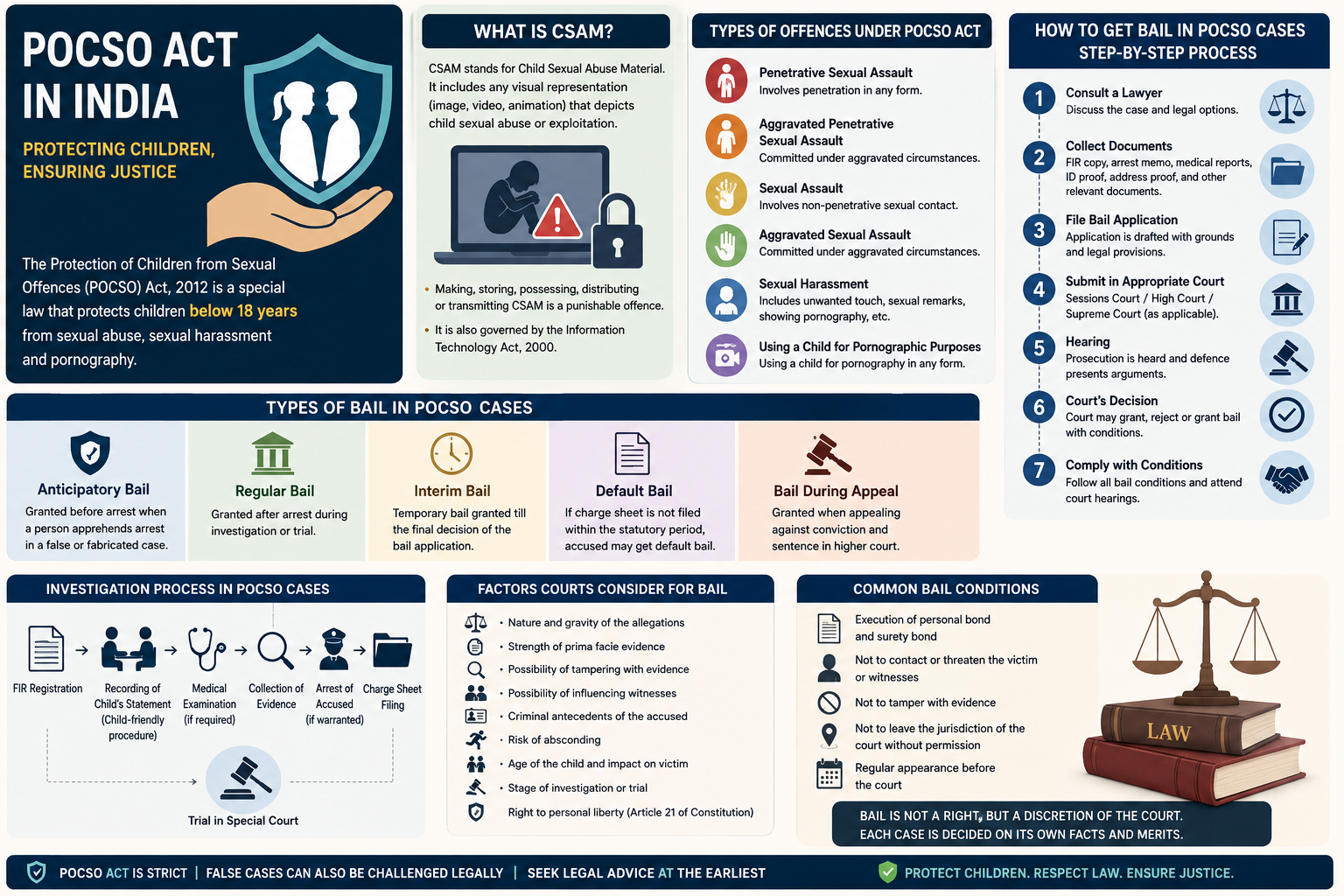
What is the POCSO Act?
The POCSO Act came into force on 14 November 2012 with the objective of providing a comprehensive legal framework to protect children from sexual offences. Before POCSO, Indian law did not contain a dedicated child-specific statute covering the full range of sexual offences against minors.
The Act defines a child as any person below 18 years of age and provides:
- Gender-neutral protection
- Child-friendly investigation and trial
- Mandatory reporting of offences
- Confidentiality of the child’s identity
- Special POCSO Courts for speedy trials
- Strict punishments for offenders
Objectives of the POCSO Act
The law aims to:
- Protect children from sexual abuse and exploitation.
- Criminalize sexual assault, sexual harassment, and use of children for pornographic purposes.
- Ensure child-sensitive investigation procedures.
- Protect victims from intimidation and repeated trauma.
- Provide speedy justice through Special Courts.
- Punish offenders with stringent imprisonment and fines.
What is CSAM?
CSAM stands for Child Sexual Abuse Material.
This term is now preferred over “child pornography” because it more accurately reflects that the content documents or depicts the sexual abuse or exploitation of a child rather than consensual adult pornography.
CSAM can include:
- Images of child sexual abuse
- Videos depicting sexual exploitation of children
- Digitally created or manipulated sexual depictions of children where prohibited by law
- Distribution or publication of such material
- Certain forms of storage, possession, transmission, or access that are criminalized under applicable law
Indian law contains offences relating to using a child for pornographic purposes under the POCSO Act, while online publication, transmission, and related digital offences may also attract provisions of the Information Technology Act, 2000 and other applicable laws.
Types of Offences Under the POCSO Act
The Act broadly covers:
1. Penetrative Sexual Assault
This includes various forms of sexual penetration involving a child as defined by the Act.
2. Aggravated Penetrative Sexual Assault
The offence becomes aggravated when committed under specified aggravating circumstances, such as by a person in a position of trust or authority or in other situations defined by the Act.
3. Sexual Assault
Covers sexual acts involving physical contact without penetration, as defined by the Act.
4. Aggravated Sexual Assault
Enhanced punishment applies where aggravating circumstances specified in the Act are present.
5. Sexual Harassment of a Child
Examples include sexually coloured remarks, repeated unwanted contact with sexual intent, or showing pornographic material to a child.
6. Using a Child for Pornographic Purposes
The Act criminalizes using a child in pornographic content and provides enhanced punishment where additional sexual offences are committed in connection with such use.
Mandatory Reporting Under POCSO
The Act imposes a legal duty on persons who become aware of a POCSO offence to report it to the authorities. Failure to report may itself attract legal consequences.
Investigation Process in a POCSO Case
A typical investigation includes:
- Registration of an FIR.
- Recording the child’s statement using child-friendly procedures.
- Medical examination where required by law.
- Collection of documentary, forensic, digital, and other evidence.
- Recording witness statements.
- Arrest of the accused where warranted.
- Filing of the charge sheet.
- Trial before the designated Special Court.
Special Courts Under the POCSO Act
POCSO cases are generally tried by designated Special Courts to ensure:
- Faster disposal
- Child-friendly proceedings
- Protection of the child’s identity
- In-camera hearings where required
- Reduced trauma to the victim
Are POCSO Cases Bailable?
Most POCSO offences are cognizable and non-bailable.
This means:
- Police may arrest without a warrant where the law permits.
- Bail is not automatic.
- The accused must apply to the appropriate court.
- The court decides whether bail should be granted after considering all relevant circumstances.
Importantly, non-bailable does not mean bail is impossible. Courts retain the power to grant bail in appropriate cases under the BNSS.
Types of Bail in POCSO Cases
1. Anticipatory Bail
Filed before arrest where a person reasonably apprehends arrest. Whether anticipatory bail is granted depends on the facts of the case and judicial discretion.
2. Regular Bail
Filed after arrest seeking release during investigation or trial.
3. Interim Bail
Temporary bail granted pending final consideration of the main bail application.
4. Default (Statutory) Bail
May arise if the prosecution fails to complete the investigation and file the charge sheet within the period prescribed by law, subject to the applicable legal requirements.
5. Bail During Appeal
A convicted person may seek suspension of sentence and bail while an appeal is pending.
Step-by-Step Process to Get Bail in a POCSO Case
Step 1 – Consult a Criminal Defence Lawyer
An advocate reviews:
- FIR
- Complaint
- Medical reports
- Witness statements
- Digital evidence
- Charge sheet (if filed)
Step 2 – Identify the Appropriate Type of Bail
Depending on the stage of the case, the lawyer determines whether anticipatory, regular, interim, or another form of bail is appropriate.
Step 3 – Prepare the Bail Application
The application generally includes:
- Facts of the case
- Legal grounds
- Personal circumstances
- Supporting documents
- Relevant judicial precedents
Step 4 – File Before the Competent Court
Applications are generally filed before:
- Special Court / Sessions Court
- High Court
- Supreme Court (where applicable)
Step 5 – Hearing
The prosecution opposes or responds to the application, and the defence presents its arguments.
Step 6 – Court Considers Relevant Factors
Courts may consider:
- Nature and gravity of allegations
- Strength of prima facie evidence
- Risk of absconding
- Possibility of influencing witnesses
- Criminal antecedents
- Stage of investigation
- Need for custodial interrogation
- Protection of the child
- Constitutional right to personal liberty
Step 7 – Bail Order
If bail is granted, the court may impose conditions such as:
- Furnishing bail bonds
- Attending court hearings
- Not contacting the child or witnesses
- Not tampering with evidence
- Restrictions on travel
Common Grounds Raised in Bail Applications
Depending on the facts of the case, grounds may include:
- Weak prima facie evidence
- Delay in lodging the FIR
- Completion of investigation
- Charge sheet already filed
- No criminal history
- Low risk of absconding
- No likelihood of influencing witnesses
- Long period of incarceration pending trial
Whether these grounds succeed depends entirely on the evidence and judicial assessment in the specific case.
Can Bail Be Rejected?
Yes.
Courts may refuse bail where they believe release could:
- Prejudice the investigation
- Lead to witness intimidation
- Result in evidence tampering
- Increase the risk of absconding
- Endanger the child
- Be inconsistent with the seriousness of the allegations
Frequently Asked Questions
Is every POCSO offence non-bailable?
Most offences under the Act are procedurally non-bailable, meaning bail is discretionary rather than automatic.
Can a person get bail in a false POCSO case?
Courts decide bail based on the evidence and applicable legal principles. There is no automatic entitlement or automatic denial.
Which court grants bail?
Depending on the stage of proceedings, the Sessions Court, High Court, or Supreme Court may consider bail applications.
Can bail be cancelled?
Yes. Courts may cancel bail if conditions are violated, evidence is tampered with, witnesses are threatened, or other legally recognized grounds arise.
The POCSO Act is one of India’s most important child-protection laws, providing a comprehensive framework to prevent and punish child sexual abuse, including offences involving CSAM. At the same time, India’s criminal justice system recognizes the constitutional principle that an accused person is presumed innocent until proven guilty in court. While most POCSO offences are non-bailable, the law allows courts to grant bail after carefully evaluating the evidence, the seriousness of the allegations, the rights of the child, and the rights of the accused.
Disclaimer: This article is intended for educational and informational purposes only and does not constitute legal advice. Individuals involved in a POCSO case should consult a qualified advocate for advice based on the specific facts of their case.